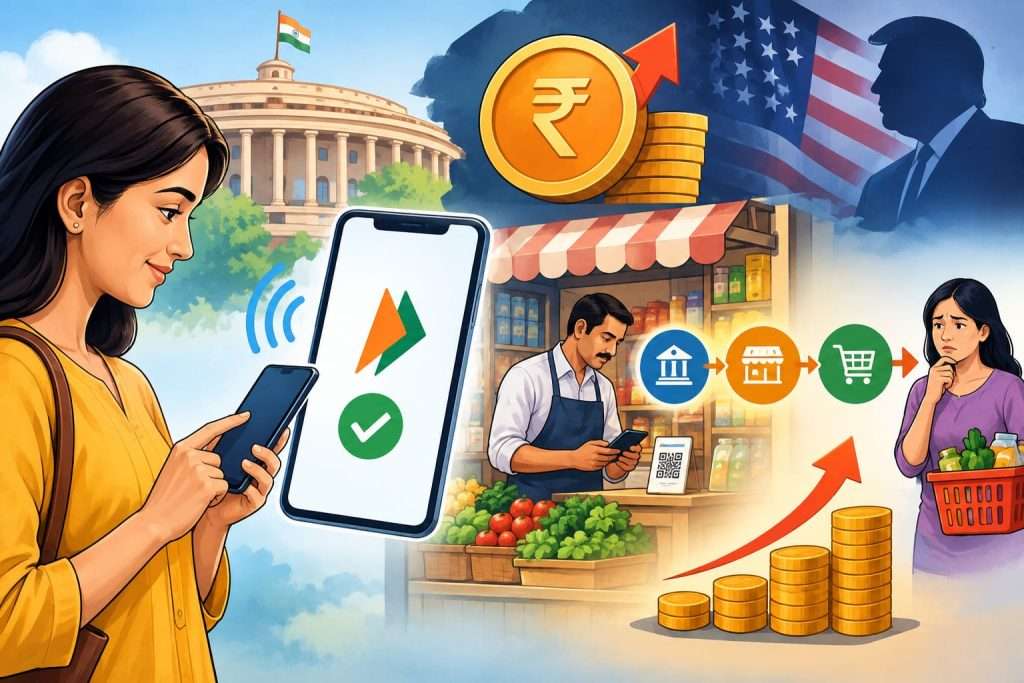
UPI Transactions Up to ₹2,000 Remain Free; Possible Charges on Higher-Value Payments Raise Concerns for Consumers and Merchants
New Delhi, September 17, 2026 | (SDNA)
By Dr. Priyanka Saurabh
The conclusion that American pressure has finally influenced the decision may appear attractive, but the September 14 notification of the Ministry of Finance needs to be understood with some caution. The notification prohibits banks and payment system providers from imposing direct or indirect charges on UPI transactions up to ₹2,000 and payments made through RuPay debit cards. However, no immediate consumer charge has been imposed on UPI payments above ₹2,000. The notification has only left open the possibility of introducing charges or MDR on larger transactions in the future.
Will the Cost of Charges Eventually Reach Consumers?
The concern, however, is genuine. The impact of a policy cannot be understood merely by looking at the words used in a notification; it is also important to observe how the market responds afterward. A charge may not be imposed directly on customers today, but it could be imposed on merchants tomorrow, and merchants may eventually add that cost to the prices of goods and services. In an economic system, a new cost rarely remains confined to its original point; it can spread through prices, commissions or service charges.
The government’s current decision does not mean that every UPI payment above ₹2,000 has now become chargeable. The notification specifically provides that banks and payment system providers cannot impose any direct or indirect charge on the payer or recipient for UPI transactions up to ₹2,000. For larger transactions, no fixed rate has been announced, nor has it been stated that ordinary users will immediately have to pay an additional amount.
MDR Debate Adds to the Concern
The possibility of imposing MDR (Merchant Discount Rate) on UPI has been discussed for some time. MDR refers to a charge associated with processing digital payments, typically involving merchants and entities connected with the payment system. If MDR is introduced on merchant payments above ₹2,000 in the future, banks, payment applications and payment processors may seek to recover their operational costs. This is where concerns among citizens begin to emerge.
The government may argue that small payments will remain free for low-income, lower-middle-class and everyday consumers. This argument is understandable in itself. Keeping payments for tea, milk, vegetables, local transportation and small shops free is important for digital inclusion. But the question remains whether any future charges on payments above ₹2,000 would be restricted to large businesses. If so, who would monitor compliance?
Could Small Merchants Face an Additional Burden?
It is difficult to assume that merchants will always absorb additional costs from their own profits. Large organized businesses may be able to bear payment-processing costs for some time, but every additional charge matters to small businesses. Grocery stores, online sellers, private tutors, doctors, repair workers and small service providers may eventually pass their increased costs on to customers in one form or another.
For instance, imagine that a merchant is charged one percent on every large UPI payment. The merchant may ask customers to pay in cash, demand an additional amount for digital payments, or make a small increase in the price of goods. Even if the customer does not see a separate payment charge, they may still end up paying more through higher prices.
Therefore, it is not enough to simply say that the charge will be paid by the “recipient.” The recipient is also part of the market, and any additional cost may eventually be reflected in prices.
Maintaining Trust in UPI Is Essential
The convenience of digital payments has made UPI an integral part of everyday economic activity in India. Customers no longer need to worry about whether they have sufficient cash or a card. A transaction can be completed within seconds using a mobile phone and bank account.
However, if additional charges on larger payments, failed transactions, different rates across applications or arbitrary surcharges by merchants become common, confidence in the system could be affected.
The allegation that American companies or the Trump administration exerted pressure is an important part of the political debate. However, it should not be presented as an established fact without concrete documents, official statements and publicly available records of relevant discussions. International companies often engage with governments to protect their commercial interests. Therefore, reducing the policy decision to a single external factor could leave the domestic economic dimensions of the issue unexplored.
Transparency from the Government Is Important
UPI requires expenditure on large-scale operations, cybersecurity, technical infrastructure and customer support. At the same time, the government has for years promoted UPI by keeping transactions at little or no cost to users. If questions about the cost of maintaining this system are now emerging, the government should transparently explain the total cost involved, who will bear it, and how any revenue generated through charges would be utilized.
The issue should be discussed through transparent economic analysis rather than being presented primarily through nationalist rhetoric. If the decision has been taken not because of foreign pressure but because of domestic economic requirements or the need to maintain the stability of the payment system, that should be clearly communicated. If international negotiations have had any influence, the available official information should also be made accessible to the public.
Four Key Issues Need Attention
If any charges are introduced on larger UPI transactions in the future, at least four issues will require attention: the charge rate should be publicly disclosed and reasonable; small merchants should not face an disproportionate financial burden; hidden surcharges on customers should not be permitted; and competition among payment service providers should remain intact. A clear grievance-redressal and refund mechanism should also be established.
UPI is no longer merely a technology platform; it has become an important part of India’s everyday economy. Therefore, decisions concerning its cost structure should be taken transparently. Keeping transactions up to ₹2,000 free provides clarity, but uncertainty over potential charges on higher-value transactions continues to raise questions.
The success of UPI depends substantially on public trust. If changes concerning charges are introduced, the government should go beyond issuing notifications and clearly explain the economic reasons, potential impact and broader policy framework to the public.
(Dr. Priyanka Saurabh, PhD in Political Science, is a poet and social thinker.)