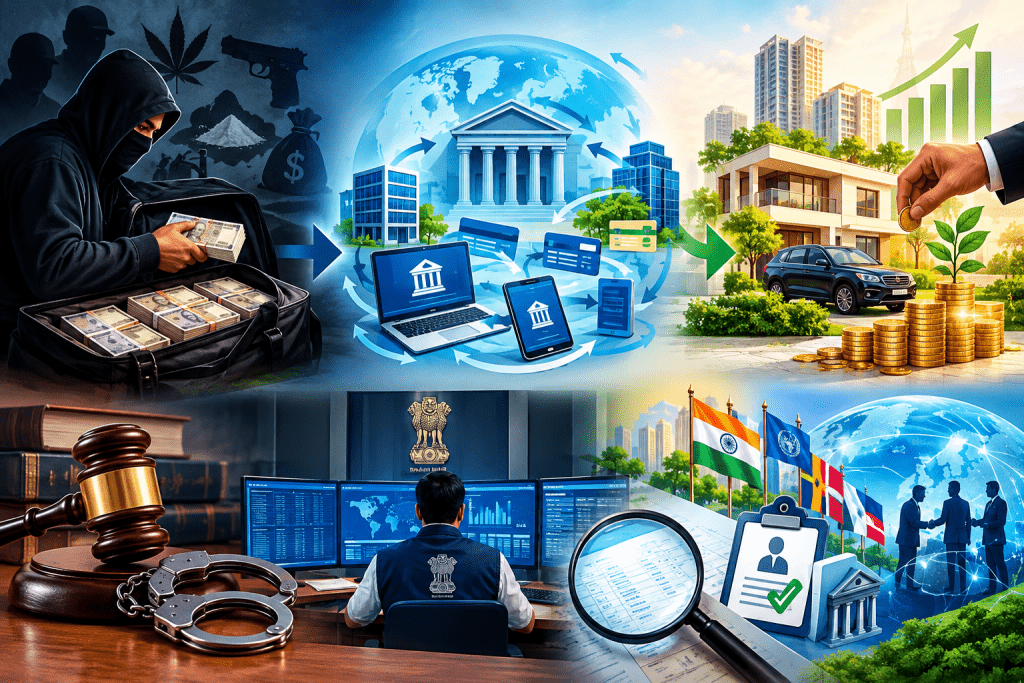
New Delhi: (sdna) Money laundering is no longer limited to being merely an economic crime. It has become an important financial support mechanism for organized crime, corruption, drug trafficking, terrorism, and illegal trade. In simple terms, money laundering is the process of concealing the actual source of money obtained through criminal activities and presenting it as legitimately earned or legally acquired wealth.
The process of money laundering is generally understood through three major stages — placement, layering, and integration. In the first stage, illegally obtained money is introduced into the financial system. This may involve depositing large amounts of illicit cash into different bank accounts, dividing the money into smaller transactions, or introducing it into the financial system through cash-intensive businesses.
The second stage is known as layering. Its purpose is to conceal the original source of the money and make it difficult for investigative agencies to trace its movement. Multiple bank accounts, companies, intermediary entities, and complex financial transactions may be used for this purpose. Money may be transferred from one account to another, from one company to another, or from one country to another. As a result, tracing the original source of the funds becomes increasingly complicated for investigating agencies.
The third stage is integration. At this stage, illicit money is brought back into the economy in a manner that makes it appear to be legitimate income or investment. The money may be used to purchase property, invest in businesses, provide capital to companies, or conduct other legitimate economic activities. As a result, concealing its criminal origin can become comparatively easier.
The biggest concern surrounding money laundering is that it creates a dangerous link between crime and the economy. Money generated through corruption, drug trafficking, illegal mining, fraud, smuggling, and organized crime can be concealed through money laundering. If illegally obtained funds can be easily converted into legitimate wealth, criminals may receive greater financial incentives to continue their activities.
Money laundering also affects the credibility of financial institutions. Banks and other financial institutions need to identify suspicious transactions and maintain appropriate records. The circulation of large amounts of illicit money within the financial system can potentially distort market competition and raise concerns about financial transparency.
In India, the Prevention of Money Laundering Act, 2002 (PMLA) provides an important legal framework for combating money laundering. The law provides for measures relating to the identification of proceeds of crime, investigation, attachment of relevant property, and further legal action in accordance with the law.
The Enforcement Directorate (ED) plays an important role in this framework. The agency investigates cases related to money laundering and takes action to trace assets allegedly derived from criminal activities. At the same time, the Financial Intelligence Unit–India (FIU-IND) analyzes information relating to suspicious financial transactions.
The Know Your Customer (KYC) system in the financial sector is also an important tool in combating money laundering. Verifying customer identities and monitoring financial activities can help identify suspicious accounts and unusual transactions. However, merely having regulations in place is not sufficient. Effective, consistent, and technologically capable implementation of these regulations is equally important.
Since money laundering often has a cross-border dimension, international cooperation is also essential. Criminals may generate money in one country, transfer it to another, and invest it in a third country. Therefore, cooperation among countries for sharing financial information, tracking suspicious transactions, and identifying illicit assets needs to be strengthened. The stronger international cooperation becomes, the more difficult it can be for criminals to misuse the global financial system.
However, the challenge has not disappeared. Digital payments, virtual assets, complex corporate structures, and international financial transactions are continuously changing the methods used for money laundering. India therefore needs to expand the responsible use of modern technologies, artificial intelligence, and data analytics for financial monitoring. Strengthening the capabilities and expertise of investigative agencies, along with improving coordination among different institutions, will also be important.
Ultimately, the fight against money laundering should not be limited to the seizure of illicit assets. Its broader objective should be to eliminate the financial benefits generated by criminal activities. Preventing criminals from easily converting illicit earnings into apparently legitimate wealth requires strong laws, capable institutions, vigilant financial systems, modern technology, transparency, and international cooperation. Coordinated efforts in these areas will be essential to prevent illicit money from entering the legitimate economy.
— Dr. Satyawan Saurabh, PhD (Political Science), Poet and Social Thinker
(SDNA)