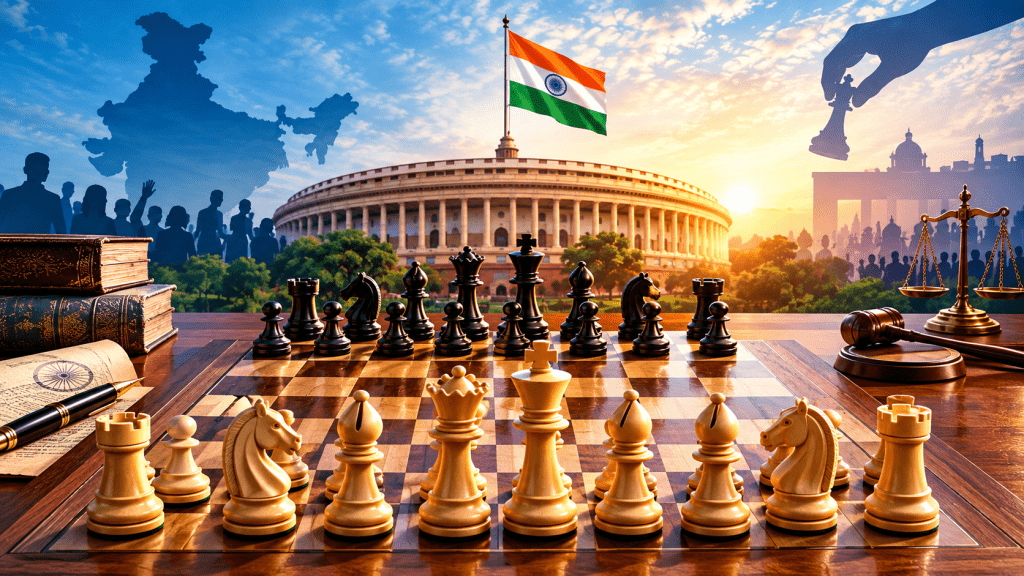
A Metaphor for Understanding Power, Strategy and Society
— Dr. Vinayak Ashok Luniya
On a chessboard, there are 64 squares and a total of 32 pieces divided between two sides. At first glance, chess appears to be a game of kings, queens, rooks, bishops, knights and pawns moving across black and white squares. However, when viewed through the lens of politics, the same chessboard becomes an interesting metaphor for power, strategy, conflict, cooperation and the balance of power.
The distinctive feature of chess is that no move exists in isolation. Every move contains the possibility of the next one. The position of one piece can change the strength or weakness of another, and sometimes even the smallest pawn can alter the direction of the entire game. Political circumstances work in much the same way—every decision affects future strategies, and power equations continue to evolve.
Interestingly, the metaphorical connection between chess and social-political systems is not new. Throughout history, attempts have been made to understand social and power structures by relating chess pieces to the roles of kings, courts, warriors, professional classes and ordinary people. In this sense, chess is not merely a game of war but also a symbolic language for understanding power and systems.
64 Squares: The Entire Political Battlefield
The chessboard is divided into 64 squares. In a political context, these can be viewed as the broader arena of society and power.
No square on the board remains important at all times. Depending on circumstances, a small square may become decisive at one moment, while its importance may change after a few moves. Similarly, in politics, the importance of issues, regions, social groups and institutions changes with circumstances.
An issue at the center of political debate today may be replaced by another tomorrow. A region that appears important in the current power equation may also experience a change in its political role as social and political conditions evolve.
This is the first political lesson of chess:
Power may appear stable, but power equations are always dynamic.
Four Central Squares: The Center of Power
d4, e4, d5 and e5 are considered the central squares in chess. Gaining control over these squares during the opening provides pieces with greater mobility and more options.
In a political metaphor, they can be understood as the center of power. The center of power is not merely the seat of government. It is also connected with organization, resources, public support, institutional influence, communication and decision-making capacity.
In other words, influence over the center in politics does not simply mean reaching the top. It also means establishing influence over the routes through which political power moves forward.
Power is not only the place where the king sits; it is also the network of paths along which other pieces can move.
Corner Squares: The Strength of the Margins
The four corners of the board—a1, h1, a8 and h8—have a distinct significance because of their limited mobility.
In a political metaphor, they can represent the marginal areas of society and politics that are often considered distant from the mainstream center. However, the history of democratic politics shows that marginal regions and relatively small groups can sometimes influence broader political equations.
Therefore, the second political lesson is:
Those whom the center considers weak may play a decisive role when circumstances change.
The King: The Centrality of Power
The king is not the most powerful piece in chess, but it is certainly the most important. Protecting the king is the ultimate objective of the game.
A direct threat to the king is called check, and when no legal means of escape remain, the situation is called checkmate.
In a political metaphor, the king can represent the top of power or the central position of governance. However, this metaphor must be understood with an important limitation in a democracy. In modern democratic systems, power is not the private property of a single individual. The Constitution, law, institutions and citizens’ rights establish limits on power.
Therefore, the metaphor of the king should be understood not as a symbol of personality worship, but as a means of understanding the centrality of power.
The Queen: A Force of Broad Influence
In chess, the queen is the most powerful piece. It can move long distances horizontally, vertically and diagonally.
In a political metaphor, the queen can represent broad influence, multidimensional power and rapid political intervention.
However, power also comes with risk. If the queen is advanced too far without adequate protection, the opponent may target it.
Similarly, in politics, a single powerful face cannot keep an organization strong for a long time. Behind that individual, there must be an established foundation of organization, workers, ideas, resources, public trust and effective communication.
An individual can create influence, but an organization gives that influence stability.
The Rook: Organizational and Institutional Power
The rook moves long distances in straight lines. Its strength becomes more apparent when the path ahead is clear.
In a political metaphor, the rook can be associated with organizational and institutional power.
A strong organization gradually establishes its position, but when its path opens, it can extend its influence over a considerable distance.
Similarly, in politics, individuals and leadership may change, but strong institutions and organizations can maintain their influence over extended periods.
An organization can outlive an individual.
The Bishop: Ideology and Long-Term Vision
The bishop is a chess piece that moves diagonally and remains on squares of the same color throughout the game.
In a political metaphor, the bishop can represent ideology, long-term vision and a particular political direction.
The bishop’s movement is not straight, but it can exert influence over a long distance. Similarly, the impact of an idea, movement or social issue may not always be immediately visible in politics. Sometimes, the seeds of an idea become evident in political outcomes only after a long period.
Some of the most influential political moves are those whose results do not appear immediately.
The Knight: Unexpected Moves and Political Turns
The knight is the most distinctive piece in chess. It moves in an L-shaped pattern and can jump over other pieces.
In a political metaphor, the knight can represent situations where a new path is created by moving beyond established routes.
Sudden political alliances, unexpected leadership changes, new issues, fresh strategies or steps that differ from an opponent’s expectations can all create new political equations, much like a knight’s movement.
The true strength of the knight lies not merely in its ability to jump, but in its unexpected direction.
In politics, not every path is straight, and not every change is visible in advance.
Pawns: The Real Ground of Politics
Each player has 8 pawns. Although they appear to be the most numerous and least powerful pieces, they play an important role in establishing the initial structure of the game.
In a political metaphor, pawns can represent grassroots workers, local organizations and broad social participation.
However, an important distinction must be made in the context of democracy.
Citizens are not pawns of any political party. In a democratic system, citizens are the fundamental source of political power. The chess metaphor helps explain that behind the visible structure of power lies broad social participation and grassroots strength.
The greatest feature of a pawn is its promotion. When a pawn reaches the opponent’s final rank, it can be transformed into a queen, rook, bishop or knight.
In a political metaphor, this represents the possibility that an individual rising from the grassroots can reach a higher leadership role through circumstances, struggle and opportunity.
The beginning may be small, but the destination does not have to be.
32 Pieces: Balance Matters More Than Power
Both sides have 16 pieces each. However, every piece has different movement patterns and strengths.
This is one of the greatest lessons of chess—all pieces are not equal, but no single piece can win the entire game alone.
Similarly, within an organization, one leader may develop strategy, another may manage the organization, someone may work at the grassroots, another may handle communication, and someone else may play a role during a crisis.
Political power is not merely a matter of numbers; it is the result of coordinating different strengths.
Sacrifice: A Small Cost, a Larger Strategy
In chess, a player may sometimes deliberately give up a piece to gain a greater strategic advantage later. This is called a sacrifice.
In politics, too, an immediate benefit may sometimes be set aside in favor of a long-term objective.
However, the distinction between the two must be understood. In chess, a piece is inanimate, whereas citizens in a democracy are individuals with free will and rights.
Therefore, using the metaphor of sacrifice in politics while treating citizens merely as pieces limits the reality of democracy.
Check: A Challenge to Power
When the king comes under direct attack, it is called check.
In a political metaphor, check can be understood as a serious challenge facing power. This may be connected with election results, changes in public opinion, shifts in parliamentary numbers, social movements, internal organizational disagreements or limitations imposed by constitutional institutions.
But check does not mean defeat.
Check simply means that the next move must now be considered carefully.
Checkmate: The Disappearance of Options
Checkmate occurs when the king is under threat and no legal way of escape remains.
There is no exact equivalent in politics because, in a democracy, even an electoral defeat does not necessarily mark the final end of a political idea, organization or individual.
Nevertheless, as a metaphor, checkmate can help explain a situation in which the options available to a political strategy continue to decrease, leaving no effective means of response.
Castling: Strategic Restructuring
In the special chess move known as castling, the king and rook change their positions together. The purpose is to improve the king’s safety and the rook’s positioning.
In a political metaphor, it can be understood as strategic restructuring of leadership and organization.
In politics, leadership periodically changes its strategy, responsibilities are redistributed, organizational structures are modified, and new political equations are formed.
However, just as castling is subject to specific rules, political changes are also possible only within the limits of rules and circumstances.
No matter how clever a strategy may be, democracy requires it to respect constitutional and institutional boundaries.
The Greatest Difference Between Chess and Politics
In chess, there are two players, and both know that they are playing a game.
In politics, there are millions of citizens, and political decisions affect their real lives, rights, economy, education, employment, security and social systems.
Therefore, calling politics a game of chess is a useful metaphor, but treating politics as nothing more than chess can become a dangerous oversimplification.
In chess, a pawn is simply a pawn.
In a democracy, citizens are not anyone’s pawns.
In chess, a player can sacrifice a piece.
In a democracy, power cannot stand above the rights of citizens.
This distinction draws the most important line between chess and democracy.
Five Major Lessons from Chess for Politics
When chess is viewed as a metaphor for politics, several important lessons emerge.
First—Every move affects the next move.
In politics, today’s decision can influence strategies in the days ahead.
Second—Power alone is not sufficient.
The right time, the right place and the right strategy are equally important.
Third—Control over the center matters.
The power that influences the center of political discourse and resources can create a broader impact.
Fourth—No single piece can win the entire game alone.
In politics, coordination among organization, leadership, ideas and public participation is essential.
Fifth—Even a pawn that appears to be the weakest can change its role when circumstances provide an opportunity.
This is one of the most important possibilities of democratic politics—an individual from an ordinary background can advance and take on a leadership role.
The Final Message of the Chessboard
There are 64 squares on a chessboard, but the possibilities are countless. There are 32 pieces, but each has a different role. One moves straight, another diagonally, one jumps, and another advances gradually.
Politics is similarly a complex system.
Sometimes power is visible at the center; at other times, a challenge emerges from the margins. Sometimes an organization demonstrates its strength, while an unexpected move changes the entire equation. Sometimes a prominent figure steps back, while a grassroots worker advances into a significant role.
Therefore, the greatest political message of chess may not be who will defeat whom.
Rather, it is this:
Who understands circumstances, who uses resources effectively, who recognizes the movement of time, and who tries to understand the consequences of several future moves by looking at the entire chessboard?
In politics, power is not merely the name of a chair. It is the name of the balance between ideas, organization, public trust, institutions, communication, strategy and time.
From this perspective, the chessboard is not merely a field of black and white squares.
It is a metaphor for understanding the relationship between power and society.
Perhaps that is why chess reminds us:
The most important piece in a game is not necessarily the one that appears the most powerful; what matters is its role across the entire board.
About the Author:
Dr. Vinayak Ashok Luniya — Honorary Doctorates in Journalism, Human Rights, Legal Awareness and Social Justice; senior journalist and thinker.
(SDNA)