— Dr. Priyanka Saurabh (SDNA)
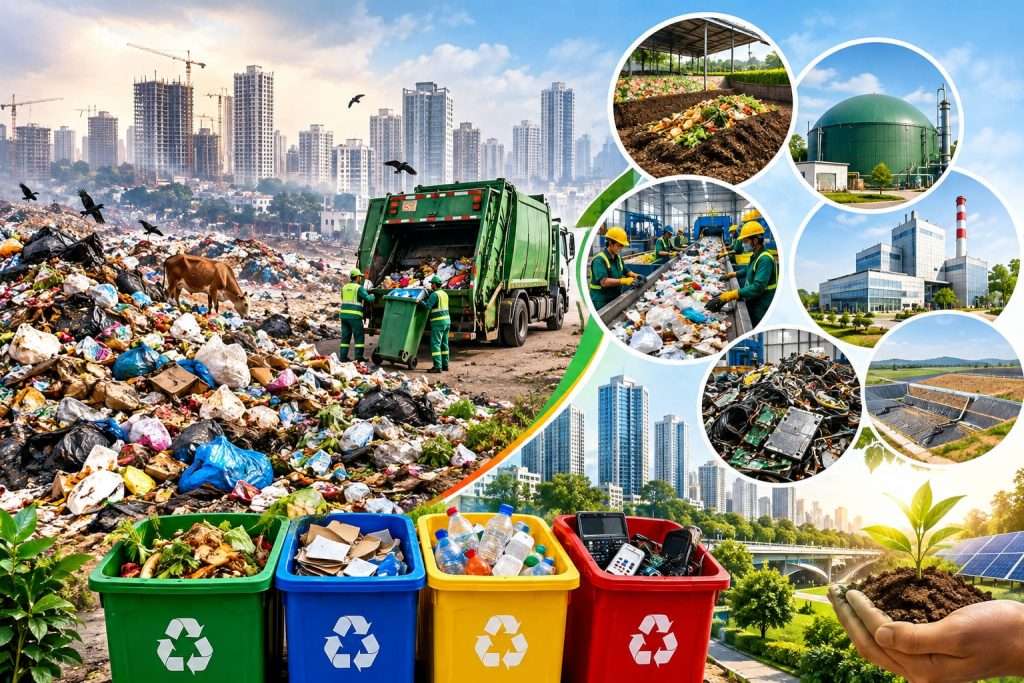
Rapid urbanization in India is creating opportunities for economic growth, employment, and an improved standard of living. However, the scientific management of the solid waste generated alongside this growth remains a major challenge. Unplanned urban expansion, population growth, changing lifestyles, consumerism, and the increasing use of single-use products have increased both the quantity and diversity of waste in cities. In many cities, waste collection, transportation, and disposal still primarily follow the ‘collect-transport-dump’ model. As a result, open dumping, waste burning, water source contamination, foul odors, air pollution, and growing pressure on landfills have become widespread concerns. Therefore, India’s challenge is not merely to remove waste but to transform it into a resource.
The nature of solid waste in India is highly diverse. Municipal solid waste generated through household and commercial activities constitutes a major portion. It includes food and other organic materials, along with paper, plastic, glass, metal, textiles, and packaging materials. The large quantity of organic waste represents both a challenge and an opportunity for India, as it can be converted into compost and biogas. Plastic waste is another major problem. Multilayer packaging and single-use plastics are particularly difficult to recycle and may enter drains, rivers, and oceans. Construction and demolition waste is also increasing rapidly. It includes concrete, bricks, stone, tiles, wood, and metal. Scientific recycling of these materials can enable their use in road construction and new building projects.
In addition, biomedical waste, e-waste, and hazardous industrial waste require special attention. Infectious materials, needles, contaminated plastics, and pharmaceutical residues from hospitals can pose serious risks to healthcare workers, waste pickers, and the general public if mixed with ordinary waste. Similarly, electronic waste generated from computers, mobile phones, batteries, and other electronic devices may contain valuable metals as well as lead, mercury, and other hazardous substances. Hazardous waste such as chemicals, solvents, paint, and industrial residues must be kept separate from ordinary municipal waste.
The first and most important technological measure for addressing this crisis is waste segregation at the source. Separating wet, dry, and hazardous waste makes the entire waste management process more effective. GPS-enabled waste collection vehicles, sensor-equipped smart bins, RFID technology, and digital tracking systems can make waste collection more transparent and efficient. However, it is important to understand that technology cannot replace civic discipline. If waste is not segregated at the household and institutional levels, even advanced processing plants will fail to deliver the expected results.
Composting and biomethanation are important solutions for organic waste. Through composting, organic waste can be converted into useful organic fertilizer, while anaerobic digestion produces biogas and organic residues. This reduces pressure on landfills while generating resources useful for energy production and agriculture. In large cities, decentralized composting and biogas plants can also reduce transportation costs and unnecessary movement of waste.
Material Recovery Facilities (MRFs) are highly useful for managing dry waste. These facilities use conveyor belts, magnetic separation, air classifiers, optical sorting, and modern sensor technologies to separate paper, metals, and different types of plastics. Artificial intelligence and computer vision-based systems could make automated sorting even more effective in the future. However, mixing wet waste with recyclable materials reduces their quality and economic value. Therefore, segregation at the source is the fundamental requirement of this entire technological process.
Mechanical recycling is relatively effective for clean and uniform types of plastic. Certain chemical recycling and pyrolysis technologies can be used for difficult-to-recycle plastics. These processes offer the possibility of producing fuel or chemical feedstock. However, their energy requirements, costs, and environmental impacts must be evaluated through life-cycle assessments. The fact that a solution is technically feasible does not automatically make it sustainable.
Waste-to-energy is another important option. Controlled incineration and Refuse-Derived Fuel (RDF) technologies can generate energy from residual waste that cannot be recycled or biologically processed. Modern emission control systems help manage pollutants. However, the calorific value of India’s mixed and moisture-rich municipal waste is often low. Therefore, burning the entire quantity of mixed waste without segregation cannot be considered an appropriate strategy. Energy generation should be viewed not as an alternative to recycling and organic processing, but as a method for managing the residual waste remaining after these processes.
Ultimately, scientific landfills remain necessary because not every type of waste can be recycled. Engineered landfills incorporate systems such as liners, leachate collection, gas capture, and groundwater monitoring to limit pollution. In India, biomining and bioremediation are also useful technologies for managing legacy waste sites. These methods can recover recyclable materials from old waste and enable the land to be brought back into productive use.
India must now move from a linear ‘produce-use-discard’ economy toward a circular economy. Reduce, reuse, repair, recycle, and resource recovery must form the foundation of urban policy. Extended Producer Responsibility, appropriate waste generation charges, the integration of waste pickers into the formal system, accountability of bulk waste generators, and strengthening the technical capacity of local bodies will be important steps in this direction.
In reality, solid waste management is not merely an engineering challenge; it is a question of urban governance, social behavior, and resource management. Technology can segregate, process, and recover resources from waste, but its effective implementation requires citizen participation, strong institutional systems, and strict monitoring. India’s cities must move beyond the mindset of ‘removing waste’ and adopt the approach of ‘turning waste into resources.’ This perspective can become the foundation for a clean, sustainable, and resource-efficient India amid growing population and urbanization.
(Dr. Priyanka Saurabh holds a PhD in Political Science and is a poet and social thinker.) (SDNA)