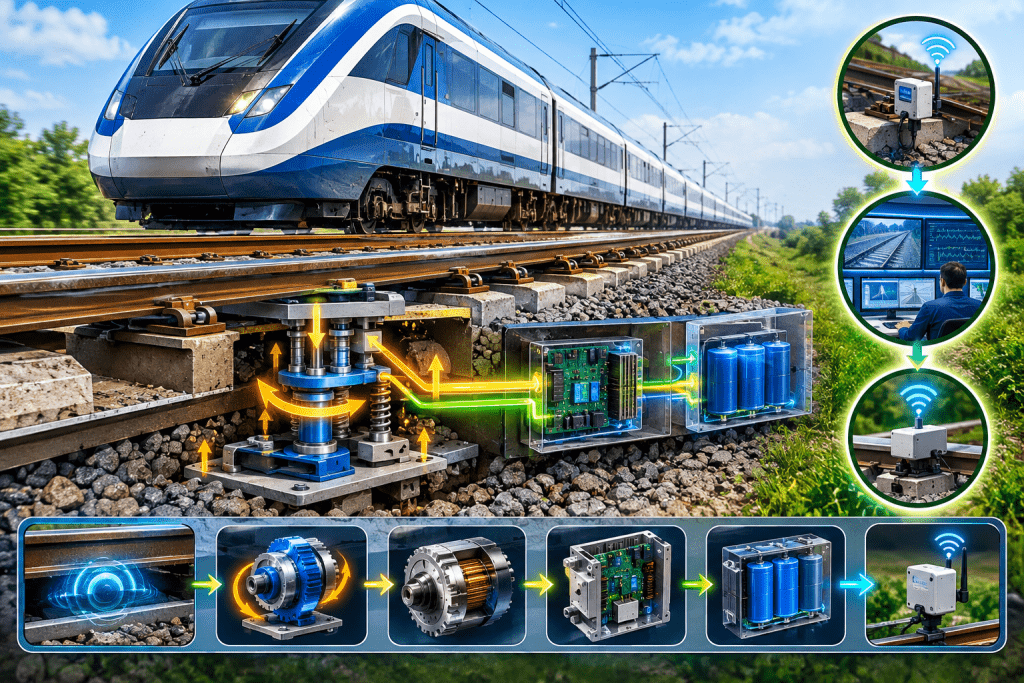
New Delhi. (SDNA) Until now, we have seen trains consuming electricity, but the equation could change in the future. As a train runs over the tracks, electricity could be generated from its weight and vibrations. Scientists have developed technology that can convert the vibrations of railway tracks into electrical energy. The most notable aspect is that this electricity could be used to operate small sensors installed for monitoring railway tracks.
Train Vibrations Will No Longer Go to Waste!
When a heavy train passes over railway tracks, it creates significant vibrations and up-and-down movements in the track. Until now, most of this energy has gone unused. The new technology captures these vibrations and converts them into electricity.
In other words, every time a train passes over the track, there is an opportunity to harvest energy from its vibrations.
From Vibration to Rotation and Rotation to Electricity
In this technology, the up-and-down movement of the railway track is converted into rotational motion through a specially designed mechanism. This rotational motion then drives a generator to produce electricity.
The system mainly consists of a vibration conversion module, generator module and power storage module. After rectification and filtering, the generated electricity can be stored in a supercapacitor.
Up to 7.44 Watts of Power with 73.38% Efficiency
The technology was tested during the research. The system demonstrated 73.38 percent efficiency and recorded a maximum peak power output of 7.44 watts during testing.
This amount of electricity is not sufficient to power an entire train or railway station, but it could be useful for small electronic devices and low-power sensors.
24-Hour Monitoring of Railway Track Safety
Sensors installed to monitor railway tracks require a continuous power supply. In such situations, this technology could help reduce the need for frequent battery replacement and extensive wiring.
The energy generated as trains pass over the tracks could power sensors, allowing track-related data to be continuously transmitted to monitoring centres. This could enhance the ability to monitor track conditions in real time.
No Sunlight, No Wind—The Train Itself Becomes the Energy Source!
Solar panels require sunlight, while wind turbines require wind. However, in this technology, the energy source is the moving train and the vibrations generated by it.
However, the technology is not intended to serve as the primary power source for operating trains. Its potential applications include powering railway sensors, monitoring systems and small electronic devices.
If the technology is successfully implemented on a large scale, it could become a new step toward reducing the railway track monitoring system’s dependence on external electricity supplies and batteries.